Dwarf planet264 M km from Earth
Ceres: a quarter of the asteroid belt
Ceres is the largest object in the asteroid belt and holds a quarter of its mass. Its bright spots are salts. Facts with their sources.
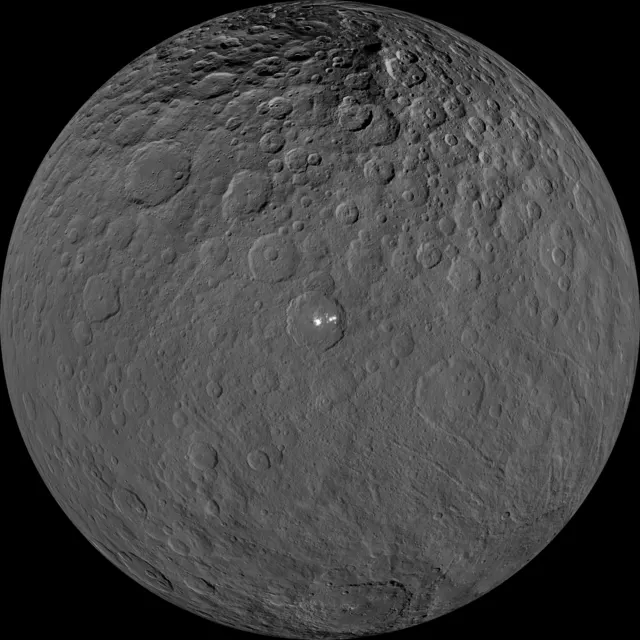
Curious facts
-
The biggest in the belt
Ceres is the largest object in the asteroid belt, between Mars and Jupiter, and on its own it holds 25% of the whole belt’s mass. 1
-
The whole belt weighs less than the Moon
Add up every asteroid and the total mass is still less than that of our Moon. 2
-
The bright spots are salts
The bright spots in Occator crater, photographed by Dawn, are salts: sodium carbonate, not table salt. 3
Frequently asked questions about Ceres
Is Ceres a planet?
No, it is a dwarf planet, the only one in the inner solar system. Giuseppe Piazzi spotted it in 1801; it was called an asteroid for many years and was reclassified as a dwarf planet in 2006. (source: NASA, Ceres)
How big is Ceres?
About 950 km across: 1/13 the width of Earth and a little over a quarter of our Moon's. If Earth were the size of a nickel, Ceres would be about as big as a poppy seed. (source: NASA, Ceres Facts)
Is Ceres bigger than Pluto?
No. Ceres is about 950 km across and Pluto about 2,377 km, so Pluto is roughly two and a half times wider. Pluto is also 14 times more massive, even though Ceres alone holds a quarter of the asteroid belt's mass. (source: NASA, Ceres Facts, NASA, Pluto Facts)
Updates
Shall I let you know what comes next?
A new space story, another stage of the Mission or a game to try: pick what interests you and I will only write when there is something.
Ceres in Orbit
In the game, Ceres is jump 8 of the route, 264 M km from Earth. Its logbook card says:
Logbook · Jump 8
The bright spots in Occator crater are salt

Free on Android and in the browser. No ads, no purchases.
Sources
- NASA, Ceres Facts. science.nasa.gov/dwarf-planets/ceres/facts
- NASA, Asteroid Facts. science.nasa.gov/solar-system/asteroids/facts
- NASA, Ceres. science.nasa.gov/dwarf-planets/ceres
Checked between 8 and 11 October 2026.
Image: NASA/JPL-Caltech/UCLA/MPS/DLR/IDA · original