Moon629 M km from Earth
Io: about 400 volcanoes on one moon
Io, the moon of Jupiter with about 400 volcanoes, plumes over 300 km high and a 200 km lava lake. Facts with their sources, and videos.
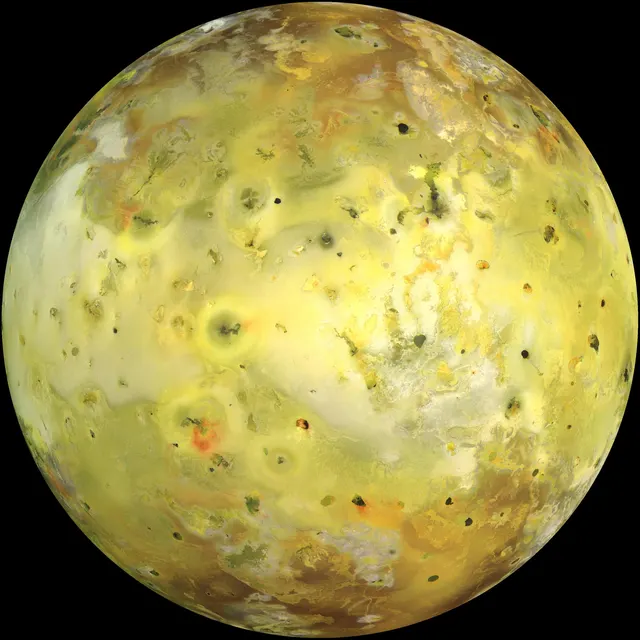
Curious facts
-
About 400 volcanoes
It is the most volcanically active world in the Solar System. JPL estimates it has about 400 volcanoes, blasting lava and plumes in almost continuous eruptions. 12
-
Plumes over 300 km high
Some eruptions throw sulphur more than 300 km up. In 2007 the New Horizons probe photographed the plume of the volcano Tvashtar: about 330 km. 34
-
Jupiter kneads it
Jupiter’s gravity stretches and squeezes it on every orbit, and its ground bulges up and down by as much as 100 metres. That constant kneading melts parts of its interior. Europa and Ganymede keep it going: for every orbit of Ganymede, Europa makes two and Io four, and those tugs keep Io’s orbit oval. 41
-
A 200 km lava lake
Between 2023 and 2024 the Juno spacecraft flew about 1,500 km above Io and saw Loki Patera, a 200 km lava lake with parts of the surface as smooth as glass. 5
Frequently asked questions about Io
Why is Io volcanic?
Because of a gravitational tug-of-war. Jupiter's huge gravity and the smaller, precisely timed pulls of Europa and Ganymede keep flexing Io, and that friction makes so much heat inside that much of the rock under its crust stays molten. (source: NASA, Io, NASA, Io: Facts)
Why is Io yellow?
Sulfur. Its volcanoes coat the surface with molten sulfur and sulfur compounds, which give it its yellowish color and patches of other shades. NASA notes that part of the surface may also be silicate rock. (source: NASA, Io: Facts)
Does Io have an atmosphere?
Yes, a very thin one, mostly sulfur dioxide from its volcanoes. When Io passes into Jupiter's shadow, about two hours in each orbit, the ground cools from about −148 °C to −168 °C and most of that gas freezes into frost, then comes back in sunlight. (source: AGU, 2016, NASA, Io: Facts)
Updates
Shall I let you know what comes next?
A new space story, another stage of the Mission or a game to try: pick what interests you and I will only write when there is something.
Videos
My shorts about Io, in Spanish.
-
 La NASA llamó a la Voyager 1… y no contestó
-
Esta luna tiene 400 volcanes
With AI-made illustrations, labelled on screen
-
 De Venus a un agujero negro: 10 cosas que parecen falsas
No video loads until you tap one. Then it comes from YouTube (youtube-nocookie.com), which receives your IP address. More in the website privacy policy.
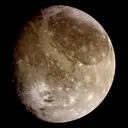
Io in Orbit
In the game, Io is jump 14 of the route, 629 M km from Earth. Its logbook card says:
Logbook · Jump 14
Most volcanically active world in the Solar System

Free on Android and in the browser. No ads, no purchases.
Sources
- NASA JPL, 2024. jpl.nasa.gov/news/nasas-juno-mission-uncovers-heart-of-jovian-moons-volcanic-rage
- NASA, Io. science.nasa.gov/jupiter/jupiter-moons/io
- NASA Photojournal, PIA09360. photojournal.jpl.nasa.gov/catalog/PIA09360
- NASA, Io: Facts. science.nasa.gov/jupiter/jupiter-moons/io/facts
- NASA JPL, 2024. jpl.nasa.gov/news/nasas-juno-gives-aerial-views-of-mountain-lava-lake-on-io
Checked between 8 and 11 October 2026.
Image: NASA/JPL/University of Arizona · original