Moon4,370 M km from Earth
Triton: the moon that goes backwards
Triton, a moon of Neptune, orbits backwards, has geysers at −235 °C and may one day break up near Neptune. Facts with their sources.
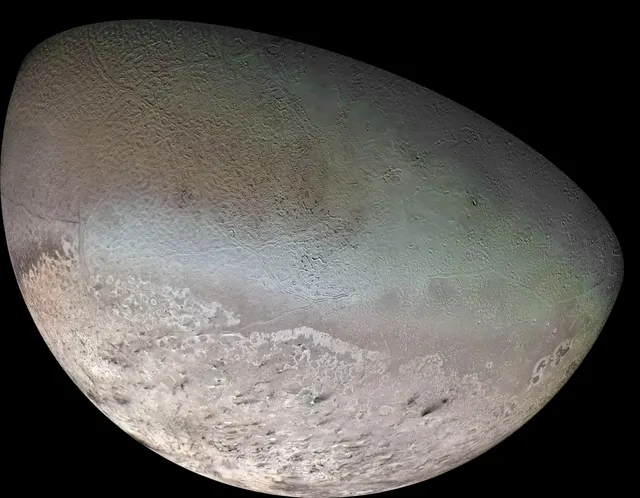
Curious facts
-
It goes backwards
It is the only large moon in the Solar System that orbits its planet in the opposite direction to the planet’s spin. Most likely it was a Kuiper Belt object that Neptune captured with its gravity millions of years ago. 1
-
Geysers at −235 °C
It is 2,700 km across and its surface sits at −235 °C. Even so, in 1989 Voyager 2 saw active geysers: columns of dark material about 8 km high, with clouds drifting downwind for more than 100 km. 12
-
It is closing in on Neptune
Because it orbits backwards, tides slow it down and bring it slowly closer to Neptune. According to a 1989 model, in about 3.6 billion years it would get so close that the planet’s gravity would break it apart, possibly into a ring. 3
Updates
Shall I let you know what comes next?
A new space story, another stage of the Mission or a game to try: pick what interests you and I will only write when there is something.
Videos
My shorts about Triton, in Spanish.
No video loads until you tap one. Then it comes from YouTube (youtube-nocookie.com), which receives your IP address. More in the website privacy policy.
Worlds related to Triton
Triton in Orbit
In the game, Triton is jump 37 of the route, 4,370 M km from Earth. Its logbook card says:
Logbook · Jump 37
Orbits backwards; Neptune probably captured it

Free on Android and in the browser. No ads, no purchases.
Sources
- NASA, Triton. science.nasa.gov/neptune/moons/triton
- Soderblom et al., Science (1990). pubs.usgs.gov/publication/70015940
- Chyba, Jankowski and Nicholson, A&A 219 (1989). ntrs.nasa.gov/citations/19890064536
Checked between 8 and 11 October 2026.
Image: NASA/JPL/USGS · original