Moon1,290 M km from Earth
Iapetus: one black face and one white
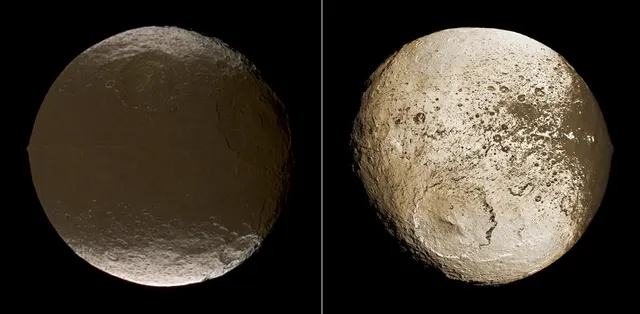
Iapetus, a moon of Saturn, has one face as dark as coal, one bright face and a 10 km mountain ridge around its equator. Facts with sources.
Curious facts
-
Two faces
The face that leads in its orbit is as dark as coal and the trailing one is much brighter: it reflects more than ten times as much light (my own sum, from NASA’s figures). 1
-
A ridge around the equator
A chain of mountains about 10 km high circles its equator. How it formed is still unclear. 12
-
Why one face is black
NASA points to two causes. Iapetus may be sweeping up dark dust from Phoebe, a more distant moon. And the dark side, which warms up more, loses its ice: it evaporates and ends up on the bright side. 1
Frequently asked questions about Iapetus
Why is Iapetus two-toned?
NASA thinks heat is the main cause: the dark side warms up more, its ice evaporates and ends up on the bright side. Giovanni Cassini suspected the two faces in 1671, because he could only see Iapetus on one side of Saturn. (source: NASA, Iapetus)
How big is Iapetus?
About 1,470 km across, Saturn's third largest moon, a little less than half the width of our Moon. (source: NASA, Iapetus)
How far is Iapetus from Saturn?
About 3,561,000 km, more than nine times the distance between Earth and the Moon. So far from Saturn and its other moons, its surface has barely been touched by tidal melting, according to NASA. (source: NASA, Iapetus, NASA, Moon Facts)
Updates
Shall I let you know what comes next?
A new space story, another stage of the Mission or a game to try: pick what interests you and I will only write when there is something.
Videos
My shorts about Iapetus, in Spanish.
No video loads until you tap one. Then it comes from YouTube (youtube-nocookie.com), which receives your IP address. More in the website privacy policy.
Iapetus in Orbit
In the game, Iapetus is jump 27 of the route, 1,290 M km from Earth. Its logbook card says:
Logbook · Jump 27
One side is coal-dark, the other snow-bright

Free on Android and in the browser. No ads, no purchases.
Sources
- NASA, Iapetus. science.nasa.gov/saturn/moons/iapetus
- Wikipedia, Equatorial ridge on Iapetus. en.wikipedia.org/wiki/Equatorial_ridge_on_Iapetus
Checked between 8 and 11 October 2026.
Image: NASA/JPL/Space Science Institute · original