Planet1,280 M km from Earth
Saturn: it would float in water
Saturn is less dense than water and its rings are raining down onto it. Curious facts with their sources and my videos about Saturn.
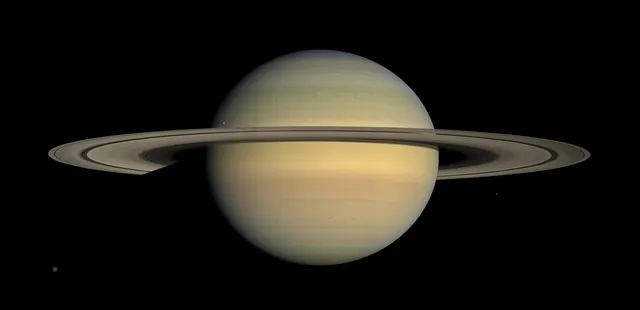
Curious facts
-
It would float in water
It is the only planet in the Solar System with an average density lower than water. Given a big enough bathtub, it would float. It is made mostly of hydrogen and helium, like the Sun. 1
-
Its rings are raining down
The rings are falling into the planet as a rain of ice particles, pulled by gravity and the magnetic field. According to a 2018 NASA study, every half hour they lose enough water to fill an Olympic swimming pool. 2
-
It may lose its rings
At that rate, adding what falls at the equator, the rings could be gone in less than 100 million years, while Saturn is over 4 billion years old. It is an estimate. The study’s author put it this way: we are lucky to be around to see them. 2
Frequently asked questions about Saturn
How big is Saturn compared to Earth?
About 9 times wider: Saturn measures roughly 120,500 km across at the equator, against 12,756 km for Earth. If Earth were the size of a nickel, Saturn would be about as big as a volleyball. (source: NASA, Saturn Facts)
Is Saturn losing its rings?
Yes, slowly. Ice from the rings rains down onto the planet, and a 2018 NASA study estimated the rings could be gone in less than 100 million years. That is an estimate, and a short time next to Saturn's age of more than 4 billion years. (source: NASA, 2018)
Is Saturn the only planet with rings?
No. Jupiter, Uranus and Neptune have rings too, but NASA says none are as spectacular or as complex as Saturn's, which are made of billions of chunks of ice and rock coated with dust. (source: NASA, Saturn Facts)
How many moons does Saturn have?
293 confirmed moons, according to NASA as of October 2026 (its latest count is from August 2026). That is more than any other planet, and the number keeps changing as more small moons are found. (source: NASA, Saturn Moons)
Updates
Shall I let you know what comes next?
A new space story, another stage of the Mission or a game to try: pick what interests you and I will only write when there is something.
Videos
My shorts about Saturn, in Spanish.
-
 Saturno se está quedando sin anillos
-
Podría llover cristal de lado (y no es lo más raro)
-
Saturno flotaría en el agua
With AI-made illustrations, labelled on screen
-
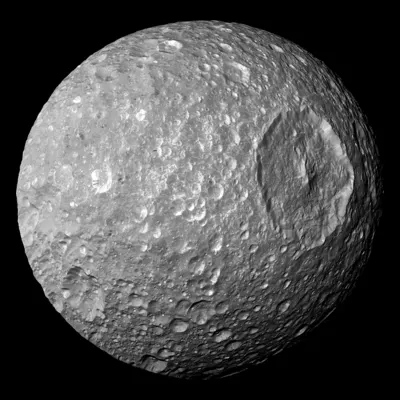 Mimas esconde un océano recién nacido
-
 De Venus a un agujero negro: 10 cosas que parecen falsas
-
 En esta luna podrías volar
With AI-made illustrations, labelled on screen
-
 La luna que escupe agua al espacio
With AI-made illustrations, labelled on screen
No video loads until you tap one. Then it comes from YouTube (youtube-nocookie.com), which receives your IP address. More in the website privacy policy.
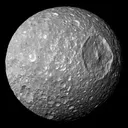
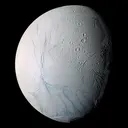
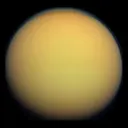
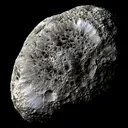
Explore Saturn in FastDator Mission
A 3D trip through Saturn, Enceladus and Titan, narrated in my voice (in Spanish). Free, in the browser, no sign-up.
Saturn in Orbit
In the game, Saturn is jump 19 of the route, 1,280 M km from Earth. Its logbook card says:
Logbook · Jump 19
It is less dense than water

Free on Android and in the browser. No ads, no purchases.
Sources
- NASA, Saturn Facts. science.nasa.gov/saturn/facts
- NASA, 2018. nasa.gov/news-release/nasa-research-reveals-saturn-is-losing-its-rings-at-worst-case-scenario-rate
Checked between 8 and 11 October 2026.
Image: NASA/JPL/Space Science Institute · original