Planet78 M km from Earth
Mars: the largest volcano in the Solar System
Mars has Olympus Mons, the largest volcano in the Solar System, and a moon that is falling onto it. Curious facts about Mars with sources.
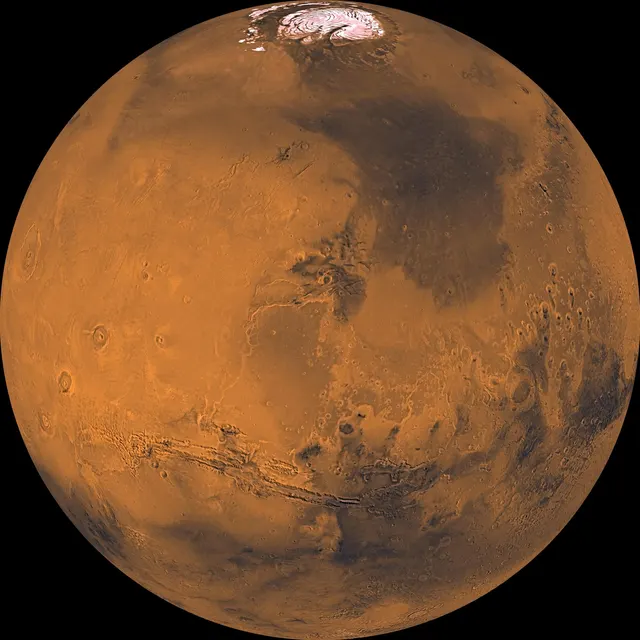
Curious facts
-
The largest volcano in the Solar System
Mars has Olympus Mons, the largest known volcano in the Solar System. It is a gently sloping shield volcano: its base covers an area the size of the state of Arizona and its summit rises far above Everest’s 8,848 m. 1
-
Its moon is falling onto it
Phobos, the larger of its two moons, gets about 1.8 metres closer to Mars every century. In about 50 million years it will crash into the planet or break up into a ring. 2
-
A moon that rises in the west
From the ground on Mars, Phobos rises in the west and sets in the east, twice every Martian day: it circles the planet in 7 hours and 39 minutes, faster than Mars spins. 34
Updates
Shall I let you know what comes next?
A new space story, another stage of the Mission or a game to try: pick what interests you and I will only write when there is something.
Videos
My shorts about Mars, in Spanish.
-
 El truco gravitatorio de la NASA para viajar a Marte
-
Marte y Júpiter casi pegados: 15 y 16 de noviembre
With AI-made illustrations, labelled on screen
No video loads until you tap one. Then it comes from YouTube (youtube-nocookie.com), which receives your IP address. More in the website privacy policy.



Mars in Orbit
In the game, Mars is jump 3 of the route, 78 M km from Earth. Its logbook card says:
Logbook · Jump 3
Home to Olympus Mons, the Solar System's largest volcano

Free on Android and in the browser. No ads, no purchases.
Sources
- NASA, Mars Facts. science.nasa.gov/mars/facts
- NASA, Phobos. science.nasa.gov/mars/moons/phobos
- NASA Photojournal, PIA06339. science.nasa.gov/photojournal/two-moons-and-the-pleiades-from-mars
- NASA APOD, 22 March 2024. science.nasa.gov/image-article/apod-2024-march-22-phobos-moon-over-mars
Checked between 8 and 11 October 2026.
Image: NASA/JPL/USGS · original