Planet92 M km from Earth
Mercury: 430 °C by day, −180 °C at night
Mercury goes from 430 °C by day to −180 °C at night, is not the hottest planet and a moon of Jupiter is bigger. Facts with their sources.
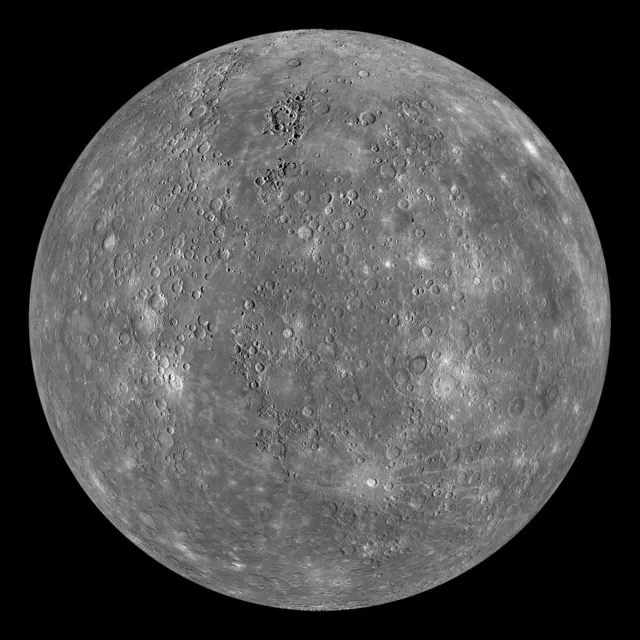
Curious facts
-
430 °C by day, −180 °C at night
It is so close to the Sun that its surface reaches 430 °C by day. With almost no atmosphere to hold that heat, it drops to −180 °C at night. 1
-
And still not the hottest
The hottest planet is Venus, even though it is farther from the Sun: its thick atmosphere traps the heat. 12
-
A moon bigger than it
Ganymede, Jupiter’s largest moon, is bigger than Mercury. In size, not in mass: Mercury weighs more. 3
Frequently asked questions about Mercury
Why is Mercury shrinking?
Its interior has been cooling since it formed, and as it cooled the planet contracted. A 2014 study using MESSENGER data found its radius has shrunk by up to 7 km, leaving wrinkles on the surface: cliffs hundreds of kilometers long. (source: Sky & Telescope, 2014 (Byrne et al., Nature Geoscience), NASA, Mercury Facts)
Is Mercury tidally locked?
No. It spins three times for every two trips around the Sun, once every 59 Earth days. The result is a very long day: from one sunrise to the next takes 176 Earth days. (source: NASA, Mercury Facts)
How many moons does Mercury have?
None. Mercury and Venus are the only planets in the solar system without a moon. Mercury is also the smallest planet, 4,879 km across, a little over a third of Earth's width. (source: NASA, Mercury Facts)
Updates
Shall I let you know what comes next?
A new space story, another stage of the Mission or a game to try: pick what interests you and I will only write when there is something.
Videos
My shorts about Mercury, in Spanish.
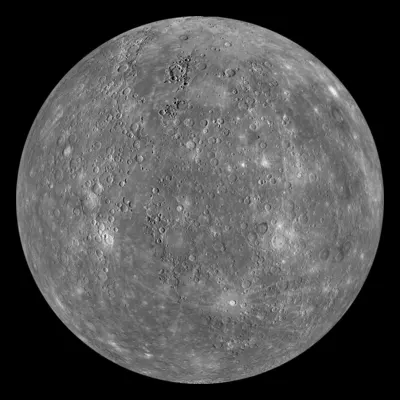
No video loads until you tap one. Then it comes from YouTube (youtube-nocookie.com), which receives your IP address. More in the website privacy policy.
Mercury in Orbit
In the game, Mercury is jump 6 of the route, 92 M km from Earth. Its logbook card says:
Logbook · Jump 6
No air: 430 °C by day, −180 °C at night

Free on Android and in the browser. No ads, no purchases.
Sources
- NASA, Mercury Facts. science.nasa.gov/mercury/facts
- NASA, Venus Facts. science.nasa.gov/venus/venus-facts
- NASA, Ganymede. science.nasa.gov/jupiter/jupiter-moons/ganymede
Checked between 8 and 11 October 2026.
Image: NASA/Johns Hopkins University Applied Physics Laboratory/Carnegie Institution of Washington · original